
How to measure for roller shades
A roller shade is unforgiving: too narrow and it lets lines of light through; and if the recess is too shallow, it will not fit. Here is how to measure, with diagrams, and what the advisor checks afterwards.
A roller shade, whether solar, blackout or translucent, is the simplest of blinds: a fabric that rolls around a tube. That simplicity makes measuring all the more important. This guide adds the points specific to rolled fabrics to our general method for measuring a window.
Step 1: choose the mount
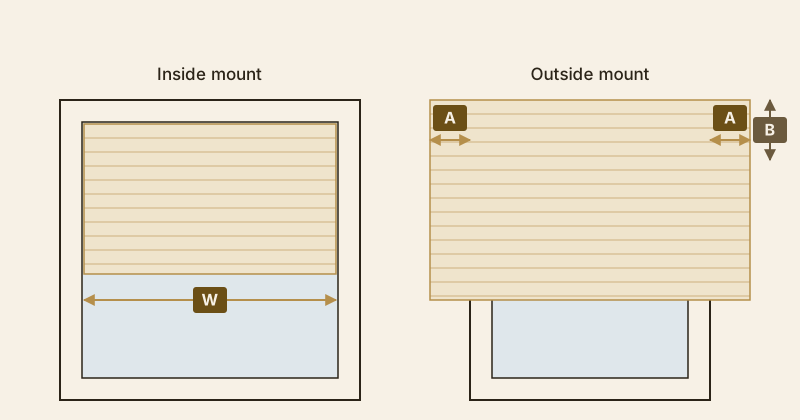
- W: the smallest of the three widths measured; the blind fits within the opening.
- A: overlap on each side, for an outside mount.
- B: overlap above the frame. A and B are confirmed by the advisor for the product.
Inside mount: the shade sits within the opening. The look is clean and the trim stays visible. You need a recess deep enough for the roll and its cassette, and you accept thin lines of light on each side, unavoidable with a rolled fabric.
Outside mount, on the wall or ceiling: the shade overlaps the frame. It is the usual choice for a bedroom or media room, because the overlap cuts light leaks, and for recesses that are too shallow or out of square. Your advisor gives you the overlap suited to the product (A and B on the diagram).
Step 2: measure width and height
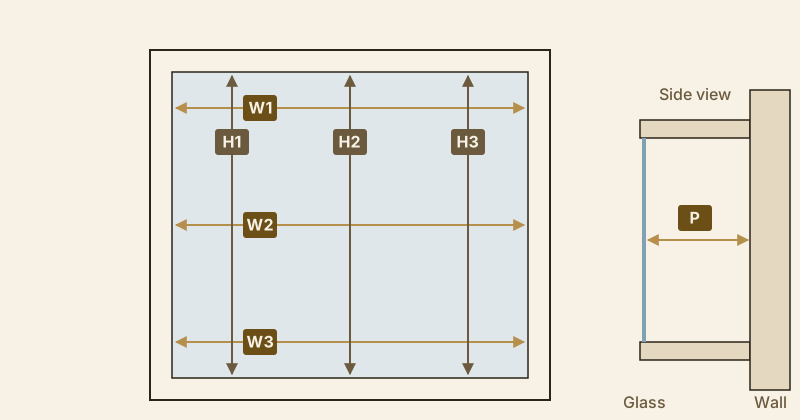
- W1, W2, W3: width at the top, middle and bottom. Inside mount: keep the smallest.
- H1, H2, H3: height at the left, centre and right.
- P: depth of the recess, from the glass to the front edge of the frame (side view).
- Measure the width at the top, middle and bottom of the opening.
- Measure the height at the left, centre and right.
- For an inside mount, record the smallest figure of each set, in inches, to the 1/8 inch. Do not subtract anything: the mechanism’s deduction is calculated at fabrication.
- For an outside mount, measure the area to cover: the opening plus the overlap you want on each side and above.
Step 3: check the depth
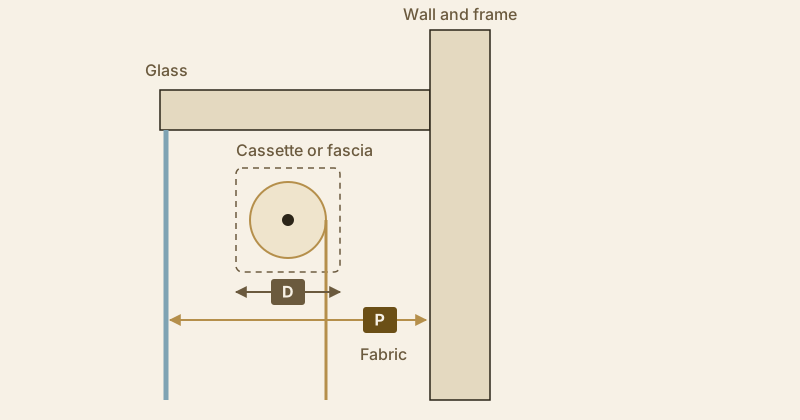
- P: available depth, from the glass to the front edge of the frame.
- D: space the roll or cassette takes; it varies by product and your advisor confirms it.
- If P is smaller than D, choose a wall or ceiling mount.
This is the most often forgotten point. Measure the available depth from the glass to the front edge of the frame (P). The roll, and the cassette or fascia that dresses it, take a certain depth (D), which grows with the window’s height and the fabric’s thickness. If P is smaller than D, an outside mount is the answer. Also note cranks, handles and mouldings that could catch the fabric on its way down.
Step 4: choose the control side
For each window, note which side you want the chain: the one that stays reachable once the furniture is in place. For a tall window, a patio door or a run of windows, motorization settles the question and lets you run everything from one remote.
What to write down
| Information | Why |
|---|---|
| Mount (inside or outside) | Changes how the dimensions are calculated |
| Width top, middle, bottom | The smallest sets the fit for an inside mount |
| Height left, centre, right | Shows whether the frame is out of square |
| Recess depth | Confirms an inside mount is possible |
| Fabric type wanted | Solar, blackout or translucent; affects the roll’s thickness |
| Chain side | Left or right |
| Obstacles | Handles, cranks, mouldings, heating |
Print our measurement sheet to keep every window in one place.
When to let an advisor measure
For fabrication we recommend having the dimensions confirmed, especially if the room must be very dark, the recess is shallow or your three measurements disagree. On request, an advisor measures each window to the 1/8 inch, included in the quote.
What next?
Compare our solar, blackout and translucent shades and our zebra blinds, then ask for a free quote. Prefer to see the fabrics in daylight? The showroom is at 865 boulevard Maloney Est in Gatineau.
What we get asked most
Why does an inside-mount roller shade let light through at the sides?
Because the fabric is always a little narrower than the mechanism: the brackets and tube take space on each side. With an inside mount, thin lines of light are therefore normal. If the room must be very dark, an outside mount with an overlap on each side is the better choice.
How deep does the recess need to be for a roller shade?
It depends on the roll diameter, which grows with the shade's height and the fabric's thickness, and on the cassette or fascia chosen. Measure the available depth from the glass to the front edge of the frame; your advisor compares it with the space the chosen product needs.
Should I subtract anything from the width I measure?
No. Give the exact opening size, the smallest of the three. The deduction the mechanism needs is calculated at fabrication for the product.
Which side should the chain go?
The most accessible side, away from a handle, a piece of furniture or a return wall. Note it for every window. For a patio door or a tall window, a motor removes the question entirely.
What about zebra (day-night) blinds?
Zebra blinds are measured exactly like a roller shade. Their roll is a little bulkier because it carries two layers of fabric, so checking the depth matters even more.
Can you come and measure?
Yes. On request, an advisor measures each window to the 1/8 inch, and the visit is included in the quote. It is the surest way to get a shade that fits perfectly.